
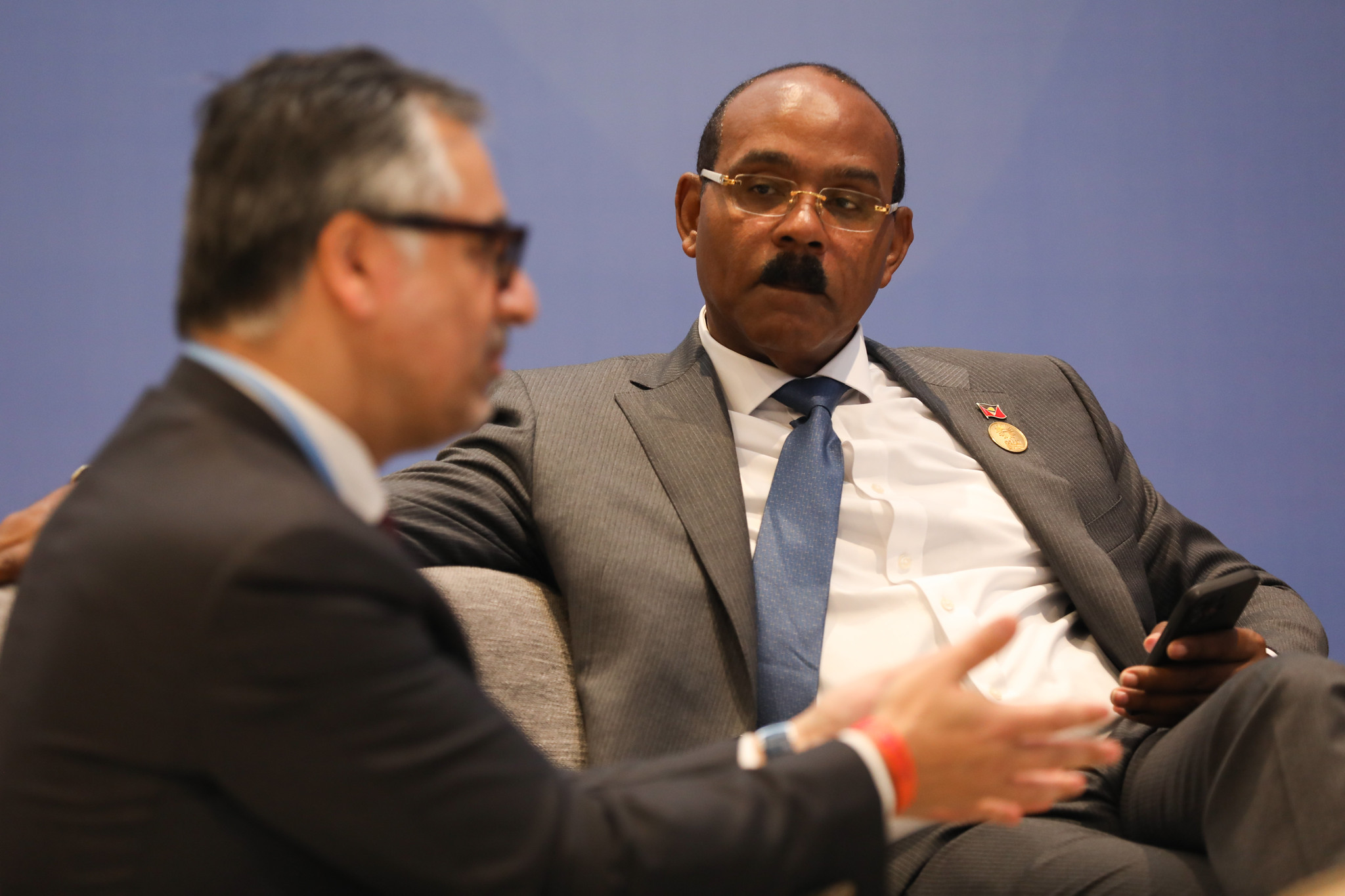
Remarks by the Honourable Gaston Browne, Prime Minister
of Antigua and Barbuda, and Chair of the Alliance of Small
Island States at a High Level Round Table at COP27
Innovative Finance for Climate and Development
Monday, 7 November 2022
What challenges do you face in securing and accessing funding for mitigation,
adaptation and just transition projects and plans?
● Good afternoon excellences and colleagues.
● Looking at the first question, the first overarching challenge faced by SIDS in
securing climate finance lies in the inadequacy, imbalance, and
unpredictability of climate finance flows. The current climate finance
ecosystem still operates on a one size-fits-all model that fails to take into
account the unique needs of SIDS.
● SIDS economies are typically small, undiversified and usually heavily
dependent on a single sector like tourism. Often this is combined with a
narrow revenue base which limits fiscal space for capital investment, resulting
in high debt levels.
● Disasters and the slow-onset effects of climate change severely impact SIDS
and cause States to redirect finance to assist with provision/rebuilding of
essential services. Any exogenous shocks SIDS experience can be
disproportionately more destructive than in larger states and thus, progress
remains fragile and can be set back suddenly and dramatically.
● These challenges have only become more acute in the social, economic and
geopolitical trying times of today and yet despite these vulnerabilities, SIDS
continue to face eligibility issues when it comes to receiving concessional
finance and Official Development Aid. The decision by OECD DAC Members
to align ODA, and therefore multilateral development bank (MDB) priorities to
the Paris Agreements goals, does not include more flexibility regarding SIDS
eligibility taking into consideration their particular vulnerability to climate
change.
● As you can see, just accessing the funds proves extremely difficult for SIDS.
● But in addition to access issues, SIDS are also faced with other challenges
making the landscape for our small states complicated. The current climate
finance landscape is complex and fragmented and the harmonization across
multinational funds is still nascent, making the process of accessing different
sources of climate finance particularly onerous for SIDS.
● You are all well aware that AOSIS has long articulated the challenges we face
both with the existence of, and gaining access to, funding for addressing loss
and damage. There are clear gaps in existing funding arrangements
to adequately assist developing countries in meeting the cost of their ex-post
responses that aim to address non-economic and economic loss and damage
associated with the adverse effects of climate change, including extreme
weather events and slow onset events.
● The gap is especially apparent in the operating entities (i.e. multilateral funds)
of the United Nations Framework Convention on Climate Change (‘UNFCCC’)
Financial Mechanism which do not presently have dedicated sources of
support to developing countries to implement ex-post responses.
What coordinated global response (e.g., creation of a Global Hub for Climate
Finance, the use of de-risking tools) can be developed to facilitate, accelerate, and
scale countries’ access to innovative climate finance?
● Looking to the second question, we have highlighted the main issues that
surround access and procedure. There clearly needs to be an ideological shift
as to how finance operates, because the current system is consistently
leaving the most vulnerable behind.
● Procedurally, the global response is simple. The Member States, IFI’s and
other entities must collectively work to remove cumbersome barriers to
climate finance.
We respect the need for due diligence, but that need to
upkeep standards should not be more important than facilitating effective and
timely response to people living in the most vulnerable countries.
● On access, there should be a global climate finance system that focuses more
on the needs of the vulnerable and truly realises the objective and purpose of
the UNFCCC and the Paris Agreement.
● The operationalisation of a new fit-for-purpose, multilateral loss and damage
response fund under the financial mechanism of the UNFCCC is a critical
piece to addressing these issues and we look forward to your support in
seeing this come to fruition.
● Thank you.