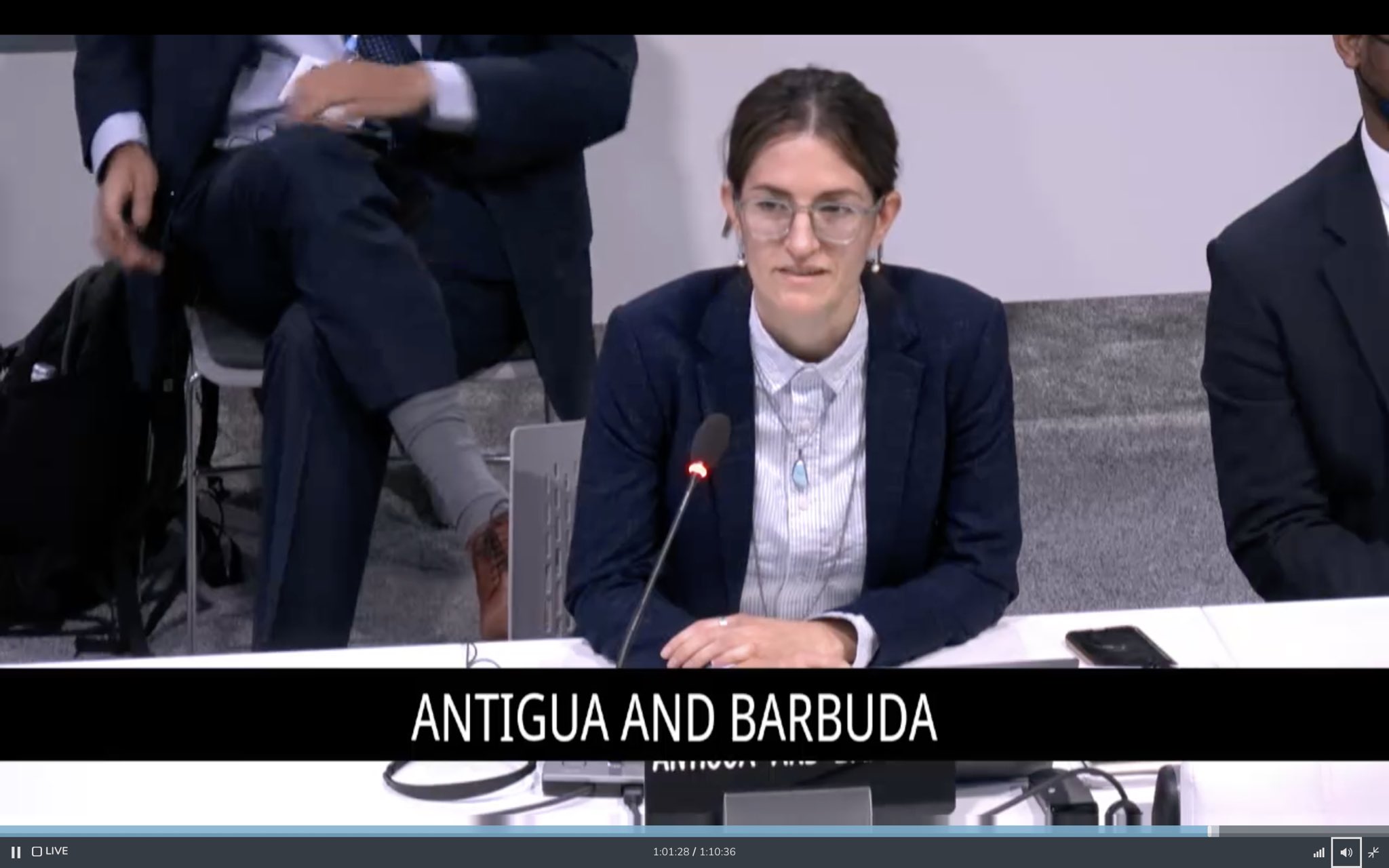
I have the honor to deliver these remarks on behalf of the Alliance of Small Island States in alignment with the statement delivered by the Group of 77 and China.
Introduction
We would first like to thank the Government of the United Kingdom for their outstanding efforts to enable COP-26 during this critical year. This year is one of the last stands for 1.5-degrees. The world is watching.
The on-going COVID-19 pandemic showed how ongoing climate change impacts exacerbate humanitarian, economic and social consequences of the health crises. SIDS were already struggling to cope with socio-economic impacts from hurricanes, cyclones, droughts and floods that continue to ravage our island nations, and this pandemic has plunged us deeper into debt. As a result, SIDS face an ever growing mountain to climb as the scale and magnitude of the climate change impacts increase as we inch closer toward a 1.5-degree world. Time is running out and during this COP we must deliver. Failure is not an option.
Climate ambition in the COP 26 outcome
Mitigation
This year’s first report of the 6th Assessment of the IPCC recently confirmed that this is our bleak future. The Climate Change Convention and the Paris Agreement guide us on how to address climate change, but commitments and actions from Parties are not aligning with agreed goals. The Paris Agreement appears to be stalling at its infancy.
Even with recent announcements, the emissions gap in 2030 to limit global warming to 1.5-degrees was only narrowed by a fraction. None of the major emitters have targets that add up to a 1.5-degrees scenario, and all these targets are yet to be implemented.
However, all is not lost. With greater ambition and urgent action, there is still an opportunity to limit the temperature increase to 1.5°C. But the window to correct course is closing fast. We call on Parties to submit their enhanced NDCs. AOSIS requests a formal platform to take stock of commitments and progress towards the 1.5-degree goal as well as the real gap and the consequences of this gap.
Adaptation
The Paris Agreement scales adaptation needs and costs according to mitigation levels. This is especially true for SIDS due to our unique national circumstances, acute vulnerability, and our limited adaptive capacity. With a trajectory of 2.7-degrees of warming, we need to increase adaptation finance to at least double above the current levels, while aiming for parity with mitigation finance. Adaptation finance should be public, grant based, predictable and accessible.
Adaptation finance and measures by their very nature are long-term investments and can have lifecycles of 20, 50, or even 100 years. We need innovative financing modalities for adaptation. Climate adaptation debt should not be on national balance sheets, and debt servicing and a debt service facility should be an integral part of our dialogue.
The Global Goal on Adaptation (GGA) was established under Article 7(1) in the Paris Agreement, in the context of the temperature goal in Article 2. Work needs to be done to define what this means, and the support needed to achieve this goal. We underscore calls for discussions on the GGA in order for Parties to engage on this critical issue and we also expect rapid and significant progress on all agenda items relating to adaptation.
Finance
Developed countries have failed to deliver the commitment made in 2009 and reinforced in 2016 to provide and mobilize $100 billion in climate finance per year by 2020 for climate action in developing countries. According to the latest delivery plan, the finance gap will be between $35 to $45 billion short by 2023. Commitments made but not kept.
Financing for the root cause of climate change is still exponentially higher than the finance to respond to climate change. Fossil fuel combustion accounted for 86% of emissions over the past 10 years and yet subsidies to this one sector in 2018 amounted to over $471 billion, compared to just $78 billi